

Essence of Ayurveda
Six Weeks of Ayurvedic Wisdom for Everyday Life
If you are here, then you probably heard about Vata, Pitta and Kapha. Maybe you even took an online quiz and know your Dosha. But Ayurveda is much more than knowing whether you are Vata, Pitta or Kapha, or following a list of foods recommended for your constitution.
Ayurveda gives us a way to understand ourselves and everything around us. Why does one person feel better in the summer while another cannot tolerate the heat? Why can the same food feel nourishing for one person and heavy for another? Why do our appetite, energy, sleep and emotions change with the seasons or even during different times of the day?
There is a logic behind all of it.
During these six weeks, we will start with the basic principles of Ayurveda—the five elements, the three Doshas and individual constitution—and then gradually apply them to food, digestion, daily routines, seasons, herbs and spices, the mind and the senses.
My goal is not for you to memorize Ayurvedic terminology. I want you to understand how Ayurveda thinks so you can begin recognizing these principles in your own everyday life.
What is Ayurveda?
The word Ayurveda comes from Ayur, life, and Veda, knowledge or wisdom. Ayurveda looks at health on more than one level and emphasizes individuality, prevention and our own role in maintaining wellbeing.
One of the first things we learn in Ayurveda is that everything in nature—including our bodies—is composed of the five great elements: Ether, Air, Fire, Water and Earth. The three Doshas—Vata, Pitta and Kapha—are different combinations of these elements and their qualities.
Once we understand these qualities, Ayurveda becomes much easier to understand.
Cold increases cold. Dryness increases dryness. Heat increases heat. Opposite qualities help bring balance.
It sounds simple—and in many ways it is. The interesting part is learning how to recognize these qualities in food, weather, digestion, daily habits, emotions and ourselves.
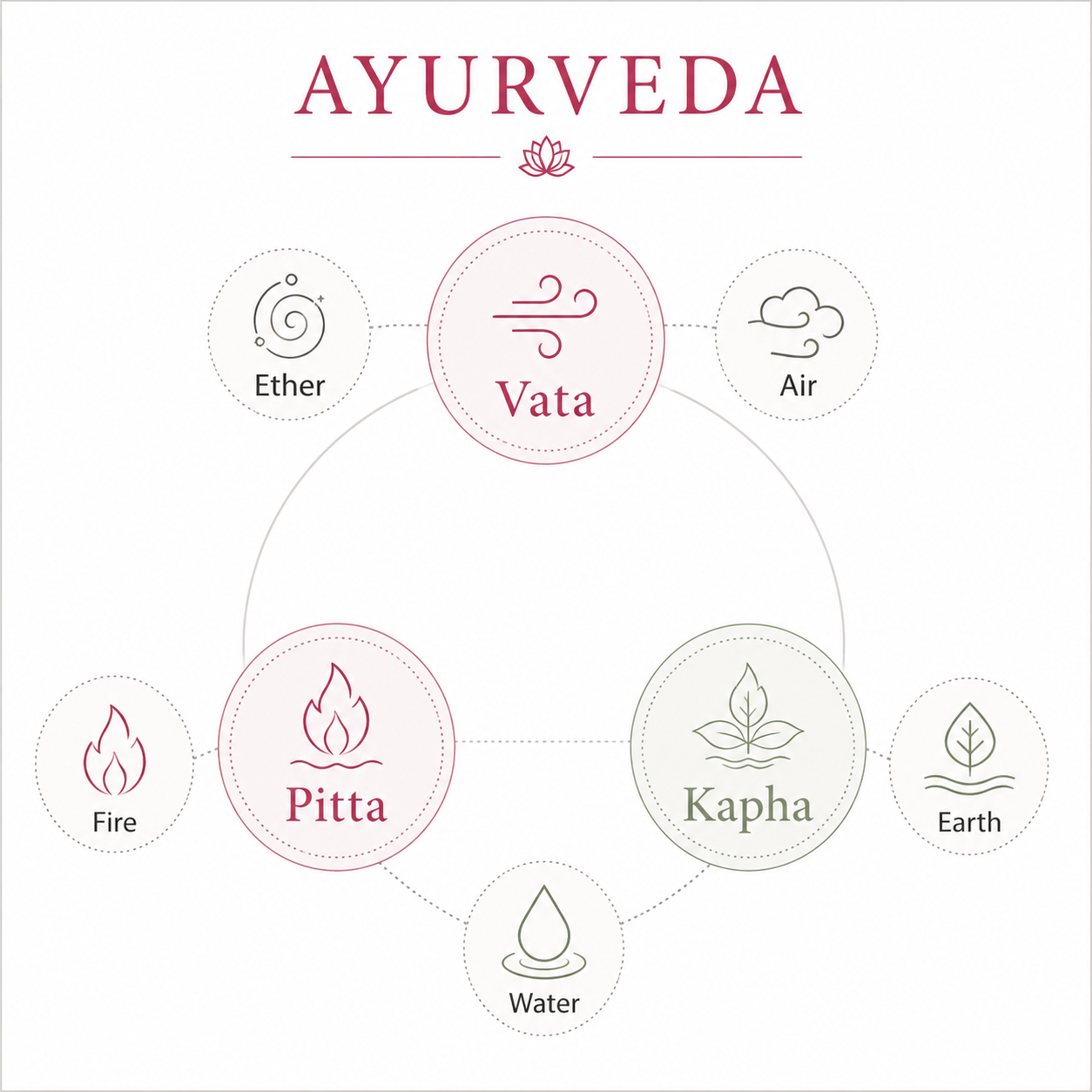
What we will study
Week 1 — Understanding Your Nature
The Five Elements • Vata, Pitta & Kapha • Prakriti & Vikriti
You will learn about the five elements and the qualities and functions of Vata, Pitta and Kapha. We will also talk about Prakriti, your individual constitution, and Vikriti, your current state of imbalance. Ayurveda makes an important distinction between the two.
We will practice observation as well. How can you recognize Vata, Pitta or Kapha qualities in a person's build, movements, speech, skin, preferences and tendencies?
The purpose is not to put everyone into three little boxes. It is to start learning how to observe qualities.
Week 2 — The Foundations of Ayurvedic Living
Food • Sleep • Breath • Perception • Daily Actions
Ayurveda places a great emphasis on prevention. We do not have to wait until something is seriously out of balance before we start paying attention.
We will explore some of the basic foundations that nourish us every day: food, water, breath, sleep and what we take in through our senses. We will look at the three pillars of life and how our everyday inputs influence both body and mind.
We will also talk about Prana, breathing practices, sleep rhythms and the effects of our everyday choices.
Sometimes very simple things make a big difference when we actually do them consistently.
Week 3 — Ayurvedic Nutrition
The Six Tastes • Agni • Ama • How, When & What to Eat
Ayurvedic nutrition is very different from simply counting calories or dividing food into proteins, carbohydrates and fats.
Ayurveda asks another question:
Can you digest it?
Your digestion is just as important as the food you put on the plate. The Ayurvedic dietary guidelines also consider when we eat, what we eat, how we eat and how much we eat.
We will study the six tastes—sweet, sour, salty, pungent, bitter and astringent—and learn how they influence the Doshas.
We will also discuss Agni, the digestive fire, its different states, and Ama, the Ayurvedic concept of incompletely digested material.
By the end of this class, I want you to look at food a little differently.
Not only: Is this food healthy?
But also: Is it right for me, right now, and can I digest it well?
Week 4 — Living in Rhythm with Nature
Daily Routines • Seasons • Time of Day • Stages of Life
We are part of nature, so naturally we are affected by its changes.
A hot summer day does not have the same qualities as a cold, windy fall day. Spring feels different from winter. Ayurveda describes how the Doshas naturally accumulate, aggravate and settle during different seasons.
Ayurvedic recommendations are not meant to stay exactly the same throughout the year.
We will talk about Ritucharya, seasonal routines, and Dinacharya, daily routines. We will also look at how Vata, Pitta and Kapha qualities appear during different times of day and different stages of life.
This is one of my favorite parts of Ayurveda because you can simply walk outside, feel the weather and start applying what you know.
Week 5 — Herbs & Spices
The Ayurvedic Kitchen • Digestion • Teas • Everyday Use
You probably already have Ayurvedic spices sitting in your kitchen.
Cumin, coriander, fennel, ginger, cardamom, turmeric, cinnamon and black pepper are not only there to make food taste better. Ayurveda uses spices to support digestion and to help balance some of the qualities of the foods we eat.
We will talk about the difference between everyday culinary spices and herbs used more specifically when there is an imbalance.
You will learn the basic qualities of common spices, which ones tend to be more appropriate for Vata, Pitta or Kapha, and how to use simple spice combinations and herbal teas in everyday life.
The goal is not to create a huge herbal pharmacy at home.
Start with your kitchen.
Week 6 — Ayurveda and the Mind
Sattva • Rajas • Tamas • The Senses • Pranayama • Mantra • Meditation
Ayurveda does not separate physical health from the mind.
In our final class, we will explore the three qualities of the mind: Sattva, Rajas and Tamas. We will talk about how sensory input, food, environment, habits and our everyday experiences affect the state of the mind.
We will also look at the Ayurvedic understanding of the proper and improper use of the senses and why what we constantly watch, hear, read and experience matters.
Most importantly, we will practice.
We will explore simple Pranayama, mantra and meditation practices and how they can help cultivate greater steadiness and Sattva in everyday life.
This is a practical course
I have taught this course several times before, and one of the things I enjoy most is watching Ayurvedic concepts begin to make sense outside of the classroom.
You start noticing the qualities of the weather.
You recognize why your digestion changes.
You notice that you feel very different after a late night than after going to bed at a reasonable time.
You start using spices differently.
And eventually Vata, Pitta and Kapha stop being abstract words. You begin to see their qualities everywhere.
Each class will include teaching, discussion and practical exercises. We will practice observing constitutional qualities, creating seasonal menus, choosing spices according to season and individual needs, and applying what we learn to everyday situations.
Who is this course for?
This course is for you if you are curious about Ayurveda and want to understand it beyond a quick Dosha quiz or a list of Vata-, Pitta- and Kapha-balancing foods.
It is designed for someone who wants to take greater responsibility for their own health and wellbeing and better understand how everyday choices—food, sleep, routines, seasons and mental inputs—can influence how we feel.
It is also for those who want practical knowledge they can use not only for themselves, but to support the wellbeing of their family. You will learn principles that can help you make more thoughtful choices around food, daily routines, spices and seasonal changes while recognizing that every person has different needs.
You do not need any previous knowledge of Ayurveda. We will start with the foundation and build everything step by step.
If you have already read books, listened to podcasts or taken Dosha quizzes but feel that the information is scattered, this course can help you understand how the different pieces fit together.
Course Details
Essence of Ayurveda
Six Weeks of Ayurvedic Wisdom for Everyday Life
6 weekly classes
In-person in Sammamish, WA
Class size will be limited to keep the course interactive and allow time for questions and discussion.
Early registration: $329
Regular tuition: $379
Dates and schedule will be announced soon.
Educational Disclaimer
Essence of Ayurveda is an educational wellness course taught by an Ayurvedic Specialist. The information provided during the course is intended for education and general wellness and is not intended to diagnose or treat medical conditions or replace individualized care from a qualified healthcare professional.